
Quick answer: The Magnificent Seven are seven giant technology stocks that have led the market for the last few years. In the first half of 2026, they cooled off while more diversified holdings held up better. That shift is a clear reminder of something we often tell clients: a disciplined, diversified plan beats chasing whatever is hot, because by the time a stock feels exciting to own, most of the gain has already happened.
Every few years, the market produces a handful of names that everyone is talking about. Right now, those names are the Magnificent Seven, and 2026 is offering a useful lesson about what happens when you build a plan around them. Here is how we think about it.
What are the Magnificent Seven?
The Magnificent Seven are seven large U.S. technology companies: Apple, Microsoft, Alphabet (Google), Amazon, Nvidia, Meta, and Tesla. They earned the nickname because they grew so large and rose so fast that their performance alone could move the entire market. Over the past couple of years, when these seven did well, the major indexes looked strong even when most other stocks were flat.
Why does everyone talk about them?
Because they became a big enough share of the market that their story became the market’s story. When a small group of stocks drives most of the gains, it creates a powerful feeling of missing out for anyone who does not own many of them. That feeling, more than the fundamentals, is what usually drives people to pile in.
How have they performed in 2026?
Through the first half of 2026, the Magnificent Seven are down about 2.5 percent, while the S&P 500 is up 10.1% and many other asset classes we allocate to are up even more.
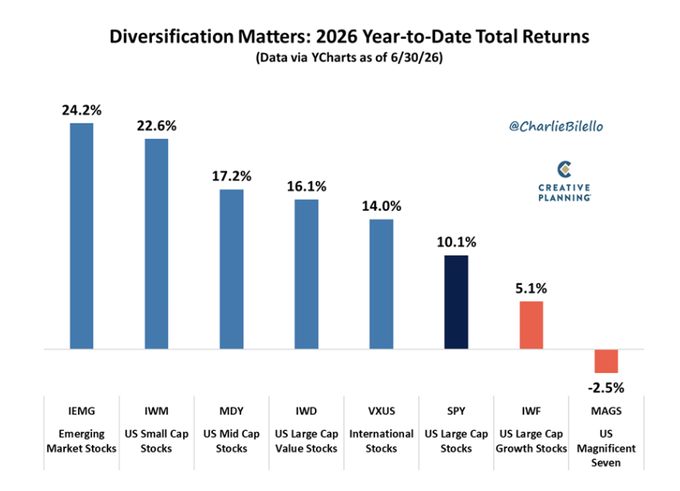
*Disclosure: Past performance is not a guarantee of future results.
Why don’t we chase them?
Because chasing performance means buying in after the run, when the price is highest, and the easy gains are behind you. It feels safe because you are buying what already worked. It is often the opposite of safe. A plan that depends on guessing which few names will lead next year is not a plan; it is a bet.
A year or two ago, some clients asked why they did not own more of these names while they were climbing. Our answer then is the same as it is now. We do not chase heat. We stay diversified and disciplined because that approach holds up across a full market cycle, not just one good stretch.
Is concentration in a few stocks risky?
Yes. When a small number of companies make up a large share of your holdings, your results become tied to the fortunes of just those few. If they stumble, so does your account. Diversification spreads that risk across many companies and asset classes, so no single stumble takes you down. That is not exciting in a year when the concentrated bet is winning. It is exactly what protects you in the year it stops.
What should you take from this?
Not that anyone called anything right. Markets will shift again, and next year, a different group of names will be the story everyone tells. The point is simpler. A steady, diversified plan is not built to win the exciting years. It is built to keep you on track through all of them, which is what actually gets you to retirement.
Frequently Asked Questions
Which stocks are the Magnificent Seven? Apple, Microsoft, Alphabet (Google), Amazon, Nvidia, Meta, and Tesla.
Should I invest more in the Magnificent Seven? That depends on your full plan, not on how they performed recently. Buying heavily into a group of stocks after a big run often means paying the highest price for the smallest remaining upside.
What does it mean to chase performance? It means investing in something mainly because it has done well lately, rather than because it fits your long-term plan. It usually leads to buying high.
Why is diversification important? It spreads your risk across many companies and asset types, so the failure of any single stock or sector does not sink your whole plan.
This article is general information and not individual investment advice. Past performance does not guarantee future results. If you want to review how your own portfolio is positioned, reach out and let’s talk.

James is the founder of SwitchPoint Financial Planning and a pioneer of the flat fee movement. He is passionate about challenging long-standing practices in the financial advice industry and refuting misconceptions about investing in an effort to help people make better decisions with their money.